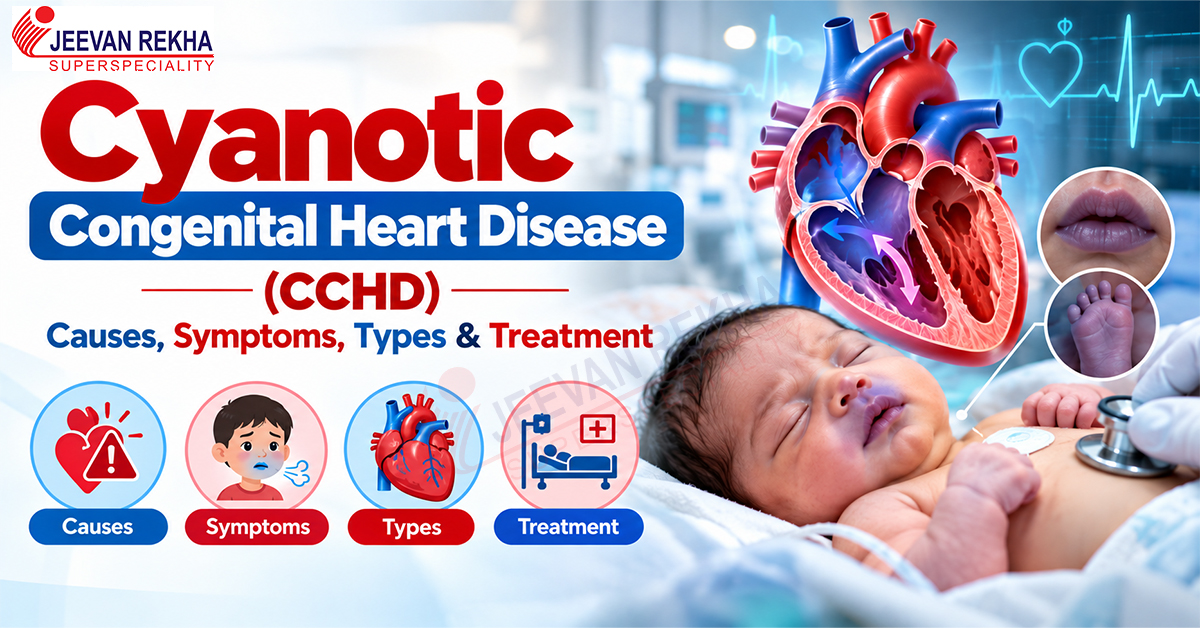
Cyanotic congenital heart disease (CCHD) refers to a group of heart defects that are present at birth. These defects reduce the amount of oxygen-rich blood that reaches the body parts. The word “cyanotic” refers to the bluish or dusky color of the skin, toungue, nail beds or lips. This occurs when blood oxygen level is low.
Congenital heart defects develop when the heart of the baby forms during pregnancy. While some defects are detected before birth, others are known after delivery or later during infancy or childhood. CCHD includes many structural abnormalities related to the heart and blood vessels. The severity level may also differ in babies; some get critically ill right after birth while others may have mild symptoms. Timely diagnosis helps in given the treatment at the right time and avoiding any complications.
A healthy heart receives blood from the body which it sends to the lungs. The lungs add oxygen to it and the oxygen-rich blood return to the heart which is pumped throughout the body. In certain conditions, the blood with poor oxygen may mix with the oxygen rich blood or may not reach the lungs. This leads to blood with less oxygen reach the entire body. A best cardiology hospital can provide specialized evaluation and treatment for children with congenital heart conditions.
CCHD can be associated with low blood oxygen levels, rapid breathing, breathlessness, poor weight gain, difficulty in feeding, bluish or dusky skin/lips, and excessive tiredness. Not every child who suffers from congenital heart defect develops cyanosis. Many congenital heart diseases are acyanotic which means the oxygen level remains normal even with structural abnormality.
The cyanotic congenital heart disease causes or the exact reason behind the congenital defect development in a baby’s heart remains unidentified. The heart develops early during pregnancy; genetic and environment may contribute to this heart disease. Possible factors which might lead to its development includes genetic or chromosomal abnormalities, maternal medical conditions, infections during pregnancy, history of congenital heart disease, maternal diabetes, or exposure to harmful substances during pregnancy.
There are seven types of cyanotic congenital heart disease. These are as follows.
1. Tetralogy of Fallot
Tetralogy of Fallot is one of the most common cyanotic congenital heart defects. It includes four heart abnormalities which affect the blood flow passing through heart and lungs. In this condition, children might have symptoms like breathing difficulty, cyanosis, poor growth, or episodes of sudden oxygen level failure.
2. Transposition of the Great Arteries
In this type, the transposition of the great arteries which are the major arteries leaving the heart, are connected to the wrong ventricles. This causes disruption in the normal blood circulation between heart, lungs and the body. Severe cyanosis may appear soon after birth requiring medical emergency.
3. Tricuspid Atresia
In tricuspid Atresia, the tricuspid valve isn’t developed normally. This means that blood cannot flow normally from the right atrium to the right ventricle. This condition leads to cyanosis and needs a special cardiac evaluation and treatment.
4. Pulmonary Atresia
This involves abnormal development or absence of normal opening through which the blood passes from the right ventricle to the lungs. The severity of this condition may vary but the newborns get critically ill as the blood flow to the lungs gets severely restricted.
5. Total Anomalous Pulmonary Venous Return (TAPVR)
In TAPVR, the pulmonary veins aren’t connected normally to the left atrium. This leads to returning of oxygen-rich blood back to the right side of the heart abnormally. The severity of the condition majorly depends on whether the blood flow from the lungs is obstructed.
6. Truncus Arteriosus
Generally, the heart has separate major arteries which carries blood to the lungs and the entire body. In truncus arteriosus, there is only a single large blood vessel which arises from the heart instead. This lets oxygen-rich and oxygen-poor blood to mix resulting in cyanosis and other symptoms.
7. Hypoplastic Left Heart Syndrome
In hypoplastic left heart syndrome, the structures on the left side of the heart are severely underdeveloped. This creates a serious condition in newborns which require urgent medical treatment.
You Can Also Read:- What Is Eagle Syndrome? Symptoms, Causes and Treatment Explained
Cyanotic Congenital Heart Disease symptoms may vary according to the type and severity of the heart defect. The common symptoms include rapid breathing, poor feeding, poor weight gain, rapid heartbeat, sweating while feeding, bluish or greyish lip and tongue, swelling, and excessive sleepiness. In some babies, cyanosis may become visible while feeding or crying. A newborn with discoloration, poor responsiveness, difficulty in breathing, and severe feeding difficulty requires urgent medical evaluation.
Cyanotic heart defects diagnosis may happen before birth, immediately after delivery, in infancy or later in childhood.
During pregnancy
A routine pregnancy ultrasound may help in identifying the structural abnormalities in the baby. If a heart defect is suspected, a fetal echocardiogram may help in getting a detailed assessment of the baby’s heart.
After birth
Doctors examine the new born for signs like abnormal heart sounds, cyanosis, breathing difficulty or poor feeding. Pulse oximetry may be done to measure the oxygen saturation of the blood by placing a sensor on the baby’s hand or foot.
Some other tests that might be done include chest x-ray, blood tests, CT scan or MRI, electrocardiogram, echocardiography, or cardiac catheterization. An echocardiogram is mainly important as it provides detailed information regarding the heart’s chambers, blood flow, valves, and major vessels.
Cyanotic Congenital Heart Disease treatment is given according to the condition, age and overall health of the baby. There are different CCHD treatments that may be given, these are as follows.
You Can Also Read:- What Are the 4 Stages of Rheumatoid Arthritis? Symptoms, Treatment & Management
The newborn is kept under observation and called for follow ups to see if there are any serious heart defects which may cause symptoms within hours or days after birth. A baby who initially seems healthy may have develop symptoms later on as circulation changes after birth.
Parents should check if the baby is having difficulty in breathing, sweats excessively during feeds, has bluish lips or tongues, or poor weight gain. In children, the symptoms may be breathlessness, tiredness during physical activity or poor growth.
Complications that may occur in case of cyanotic congenital heart disease are heart failure, abnormal heart rhythms, feeding difficulties, stroke, blood clot issues, infective endocarditis, and delayed growth and development. Children who undergo the treatment may be required to go for lifelong cardia follow-up as congenital heart disease may have certain effects which continue in adulthood.
With advancement in pediatric cardiology and cardiac surgery, the care available for children with CCHD has improved. The patient may be required to be available for lifelong monitoring of heart rhythm, heart function, nutrition, oxygen levels, exercise capacity, growth and development. Children living with this condition may or may not be able to participate in the normal activities.
If you see any of the symptoms such as severe weakness, blue or grey lips or tongue, difficulty in breathing, or rapid deterioration in the condition of the child then you should consult a doctor immediately.
Cyanotic Congenital Heart Defects or CCHD may be diagnosed during pregnancy, after delivery, during infancy or childhood. This disease may make normal living and doing daily activities challenging. At Jeevan Rekha Superspecialty Hospital, our team of specialist doctors ensure that the symptoms are timely detected and the appropriate treatment is given.
If you have seen any symptoms in your child or want to get a regular check up done, book an appointment now with our pediatrician.
1. What is cyanotic congenital heart disease?
Cyanotic heart disease is a group of heart defects which exist from birth. These defects can lower the oxygen levels in the blood abnormally. It can also lead to bluish or greyish appearance of lips, skin or tongue.
2. What are the main symptoms of CCHD?
The main CCHD symptoms are difficulty in breathing, sweating while feeding, feeding difficulties, excessive tiredness, low weight gain and in severe cases, it can lead to fainting.
3. What causes cyanotic congenital heart disease?
The CCHD causes include genetic or chromosomal factors, maternal medical conditions, certain medicines, infections, or pregnancy related factors.
4. Can cyanotic congenital heart disease be treated?
Yes. There are treatments for this heart issue like medicines, catheter-based procedures and surgery. While some conditions require urgent treatment after birth, others can be repaired later.
5. How is CCHD diagnosed in newborns?
During newborn screening, a physical examination and pulse oximetry is done which helps in measuring the blood oxygen saturation. If a problem is suspected then an echocardiogram is used to check the condition of the heart.

Jeevan Rekha Critical Care and Trauma Hospital, a unit of DR M. N. Tandon Memorial Charitable Trust is located in Jagatpura, Jaipur. The development of the institute reflects our commitment to filling the large gap that exists between demand and availability of Emergency and Critical Care Services in Rajasthan state in general and Jaipur in particular. Through continuous training and research, we aim to make difference to the outcome in these critically sick patients.
⚠️ Disclaimer: The information on the Web Site is provided for informational purposes only and is not meant to substitute the advice provided by our doctor or other health care professional. You should not use the information available on or through the Web Site for treating a health problem or disease or prescribing any medication. All images used on this website are for illustrative purposes only,
2026 © All Rights Reserved.