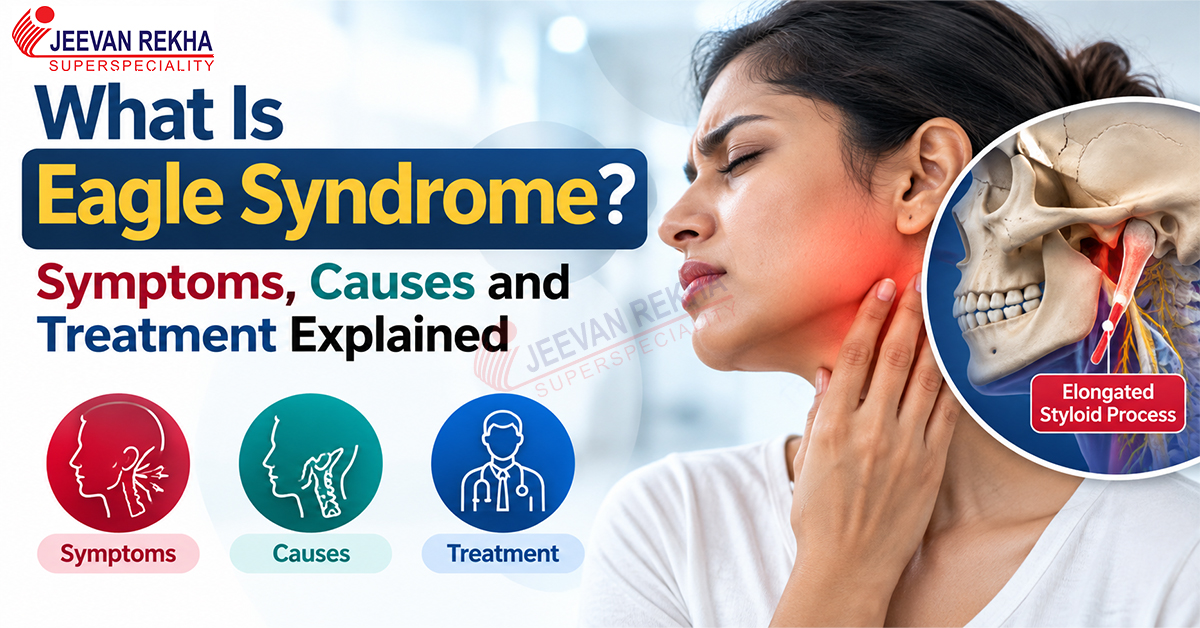
Eagle syndrome is an uncommon condition which occurs due to an elongated styloid process. The symptoms may resemble with the other common medical conditions such as dental problems, tonsillitis, temporomandibular joint, or throat disorder. This condition has been named after and American otolaryngologist Watt W. Eagle who described this syndrome in the 1930s.
In human body, the normal bony structure extending downward from the temporal bone of the skull is called the styloid process. It serves as an attachment point for several muscles and ligaments which helps in swallowing and moving the tongue and throat. In many cases, the size and position do not cause any problem but when it comes to eagle syndrome, the styloid process is elongated or there is an abnormally calcified stylohyoid ligament which may irritate the surrounding nerves, muscles or blood vessels.
The eagle syndrome causes aren’t clear that what makes the styloid process elongated or why the stylohyoid ligament gets excessively calcified. There are several factors that have been proposed which are abnormal bone growth, previous tonsil surgery, anatomical variation, throat surgery, trauma related to throat or neck, individual anatomical differences and age-related changes.
It has been observed that these symptoms may develop in some patients after the tonsillectomy or other procedures done in the throat. The scar tissue or changes in the surrounding surgical area can make the asymptomatic bony structure painful, consulting the Best ENT Hospital can help in proper evaluation and management.
The common eagle syndrome symptoms include neck pain, headache, facial pain, pain in tonsillar region/ear/throat, difficulty in swallowing, or pain during head movement. It includes
Pain that becomes worse with chewing, swallowing, yawning, or certain neck movements
Some people describe the sensation as a foreign body in the throat. Others may experience pain around the angle of the jaw or beneath the ear.
When nearby nerves or blood vessels are affected, symptoms can be more unusual and may require careful evaluation.
The symptoms of Eagle syndrome are largely related to the structures surrounding the styloid process. The elongated bone irritates the nearby tissue which further affects the nerves in throat, tongue, face and ear causing eagle syndrome pain.
In certain cases, the elongated styloid process is close to the major blood vessels in neck. This is known as the vascular form of eagle syndrome and requires immediate attention as this can serious.
Eagle syndrome is of majorly two types. These are as follows.
Vascular involvement can lead to serious consequence therefore, timely diagnosis and treatment by a specialist is necessary.
You can read also:- What Are the 4 Stages of Rheumatoid Arthritis? Symptoms, Treatment & Management
When it comes to eagle syndrome, an elongated styloid process is much more common than the symptomatic eagle syndrome. The anatomical variation plays an important role and this syndrome is mostly found in women or middle-aged adults. However, it can occur in both sexes and humans of all age groups.
Patients who have a history of throat or tonsil surgery are likely to be risk. Patients should not assume that there always be symptoms visible in case of an elongated styloid process.
The eagle syndrome diagnosis is done on the basis of medical history and physical examination. A medical specialist asks certain questions regarding the symptoms, place of pain, or any previous surgery done. He carefully studies the case and checks the place of pain. In some cases, symptoms alone are not enough to diagnose and imaging might be suggested.
A CT Scan may be suggested to diagnose this syndrome as it provides detailed information about the styloid process with the surrounding anatomical structures. A three-dimensional CT reconstruction makes the anatomy easy and helps in understanding the severity of condition. Doctor may suggest other studies if there is vascular involvement. Depending on the clinical situation, vascular imaging, and CT angiography may be suggested.
Eagle syndrome treatment is given depending on the severity of the symptoms and the elongated styloid process. There are mainly two types of eagle syndrome treatment options which are as follows.
In some cases, local anesthetic injection may be given both as a therapy or a part of diagnostic process. If it reduces the pain then it can help the diagnosis.
Eagle syndrome surgery may be recommended when an elongated styloid process appears in CT scan or X ray. It may be suggested when the symptoms are persistent, conservative treatment doesn’t work, imaging shows an abnormal anatomy, and the clinical examination support the diagnosis.
An eagle syndrome surgery involves two approaches which are intraoral approach and external approach.
Recovery varies after the eagle syndrome treatment depending on the surgical approach and the health condition of the patient. While some patients may recover fast after the removal or reduction of the styloid process, others might still have certain symptoms. The patient is likely to experience temporary pain, difficulty in swallowing, swelling and discomfort. The patient should follow the diet, and instructions given by the surgeon for better eagle syndrome recovery experience.
You can read also:- Coronary CT Angiogram: Procedure, Cost, Benefits & Risks
You should immediately consult a doctor, if you have pain in neck, jaw, ear, or throat. This doesn’t automatically indicate towards Eagle syndrome but can be a symptom. A medical check up is helpful when the symptoms are unexplained, persistent, and do not repeat. Also, if you have trouble in swallowing, or during head movement then you should get it examined.
If there are neurological symptoms like fainting, dizziness, numbness, weakness, or difficulty in speaking then this calls for an urgent medical assessment. As this condition is uncommon, doctors may first examine the general causes behind it.
Eagle syndrome is an uncommon condition which is connected with an abnormal calcification of the stylohyoid ligament or elongated styloid process. The symptoms can be pain in neck, throat, ear, or jaw or difficulty in swallowing. You should immediately get the symptoms examined by an experienced eagle syndrome specialist.
At Jeevan Rekha Superspecialty Hospital, our team of specialists are aware of the eagle syndrome risk factors, we create awareness and provide diagnostic and treatment for timely eagle syndrome management.
1. What are the most common symptoms of Eagle syndrome?
The commonly found symptoms of eagle syndrome are throat pain, jaw pain, headache, neck pain, problem in swallowing, and pain around tonsils and ear. These symptoms become worse with yawning, swallowing, chewing and during head movement.
2. What causes Eagle syndrome?
Eagle syndrome is related to elongated styloid process or abnormal ossification/calcification of the stylohyoid ligament. The reason behind these changes remains unknown but it may be due to trauma, tonsil surgery, or anatomical variations in individual.
3. How is Eagle syndrome diagnosed?
The diagnosis includes checking of medical history, imaging, and physical examination. A CT scan is done to assess the styloid process and its connection with the surrounding structure. When the vascular involvement is suspected, the additional vascular imaging may be done to be certain.
4. What treatments are available for Eagle syndrome?
The treatments available for eagle syndrome include anti-inflammatory and pain-relieving medicines, injections or surgery. The treatment given depends on the severity of symptoms and confirmation of styloid abnormality.
5. Is surgery always needed to treat Eagle syndrome?
No. In case of an elongated styloid process, surgery should not be automatically assumed. This is because some patients have mild symptoms which can be managed conservatively. Surgery is considered when the symptoms are severe or the conservative treatment is unsuccessful.

Jeevan Rekha Critical Care and Trauma Hospital, a unit of DR M. N. Tandon Memorial Charitable Trust is located in Jagatpura, Jaipur. The development of the institute reflects our commitment to filling the large gap that exists between demand and availability of Emergency and Critical Care Services in Rajasthan state in general and Jaipur in particular. Through continuous training and research, we aim to make difference to the outcome in these critically sick patients.
⚠️ Disclaimer: The information on the Web Site is provided for informational purposes only and is not meant to substitute the advice provided by our doctor or other health care professional. You should not use the information available on or through the Web Site for treating a health problem or disease or prescribing any medication. All images used on this website are for illustrative purposes only,
2026 © All Rights Reserved.